Showing posts with label classics. Show all posts

Friday, 22 January 2016

Review: The Picture of Dorian Gray by Oscar Wilde

608051THE PICTURE OF DORIAN GRAY BY OSCAR WILDE
Publisher: Random House
Format: Paperback
Series: No
Pages: 194
Date Finished: 21.01.16
Rating: 4.5/5
Summary: Dorian is a good-natured young man until he discovers the power of his own exceptional beauty. As he gradually sinks deep into a frivolous, glamorous world of selfish luxury, he apparently remains physically unchanged by the stresses of his corrupt lifestyle and untouched by age. But up in his attic, hidden behind a curtain, his portrait tells a different story...
“The books that the world calls immoral are books that show the world its own shame.”
To put it simply, this novel is fantastic. Not only is the prose absolutely beautiful, but it explores themes that most authors wouldn't dare to (especially in the stuffy, oppressive Victorian era). The Picture of Dorian Gray is bold, daring, thought provoking and philosophical. It's no wonder that most of Wilde's contemporary didn't give it the best reception.

Dorian Gray follows an eponymous protagonist who essentially trades his soul for eternal youth and beauty. The portrait of him painted by his friend Basil Hallward bears not only his age but a visible sign of the sins he commits. As well as being a fantastic novel it also has elements of being a social commentary, sometimes even using very dark cynicism to highlight the flaws of Victorian society.
“I don't want to be at the mercy of my emotions. I want to use them, to enjoy them, and to dominate them.”
Some characters are more likable than others, though they all feel extremely real. Along with most of the classics I have read (which, sadly, isn't many) I did struggle to deeply connect with the characters in the same way I have with other novels. However, that doesn't change how beautifully crafted they are. Each one serves a purpose, from Henry Wotton to Sibyl Vane. Some were sexist, some were sympathetic, and others were downright evil.

Perhaps my favourite thing about The Picture of Dorian Gray is how Wilde's life adds to the narrative. I have to admit that I don't know much about Oscar Wilde, though I do know that he was gay. The homosexual undertones to the novel are quite frankly a delight to read. They're so blatantly obvious (at least they are to me, reading in the 21st century) and it's just wonderful. Fuck you, Victorian homophobia. This book is a work of art, and I like to think that it's sticking it's middle finger up at oppression.
“Nowadays most people die of a sort of creeping common sense, and discover when it is too late that the only things one never regrets are one's mistakes.”
I genuinely see myself wanting to reread this in a few years. The prose is so good it made me want to drool, and every other sentence felt quote worthy. It wasn't overly challenging to read, and whilst there was one chapter that dragged I was hardly ever bored. The Picture of Dorian Gray is a classic that's lasted the test of time, and I completely understand why.
“Some things are more precious because they don't last long.”

Tuesday, 5 January 2016

Review: A Room With a View by E.M. Forster

15994573A ROOM WITH A VIEW BY E.M. FORSTER
Publisher: Penguin
Format: Paperback
Series: No
Pages: 221
Date Finished: 31.12.15
Rating: 3.5/5
Summary: "But you do," he went on, not waiting for contradiction. "You love the boy body and soul, plainly, directly, as he loves you, and no other word expresses it ..."

Lucy has her rigid, middle-class life mapped out for her until she visits Florence with her uptight cousin Charlotte, and finds her neatly ordered existence thrown off balance. Her eyes are opened by the unconventional characters she meets at the Pension Bertolini: flamboyant romantic novelist Eleanor Lavish, the Cockney Signora, curious Mr Emerson and, most of all, his passionate son George.

Lucy finds herself torn between the intensity of life in Italy and the repressed morals of Edwardian England, personified in her terminally dull fiancé Cecil Vyse. Will she ever learn to follow her own heart?

A Room With a View by E.M. Forster is a little novel that manages to tackle a great number of themes in its few pages. From the summary it may seem like a frivolous story surrounding a love triangle, but that is almost definitely not the case. Ultimately, it criticises the many flaws of society in 1908, it's date of publication, and presents many ideas that have significant merit, even today.
"I want you to have your own thoughts even when I hold you in my arms."
The novel follows Lucy Honeychurch, firstly during her holiday in Italy and secondly back at her home in Surrey. Essentially Lucy has to choose between George Emerson, a man considered beneath her in terms of class yet someone she could live a passionate life with, and Cecil Vyse, a wealthy yet generally boring and selfish man. There are definitely other aspects to the novel such as the elements of social critique and the cast of varied characters.

A Room With a View is a book I'm required to read for my A Levels. I'm not honestly sure that I would have picked it up otherwise, and whilst I am glad that I did I wouldn't be surprised if months of in depth analysis eventually kill it for me. I did quite like it, yet my general attitude towards Forster's novel isn't full of praise simply because I didn't fall in love with it. It is a great work of literature that can definitely be analysed in detail, but in terms of enjoyment it didn't blow me away.
“Life' wrote a friend of mine, 'is a public performance on the violin, in which you must learn the instrument as you go along.”
Perhaps the best element of the novel was Lucy herself. Starting out naive, Lucy's bildungsroman saw her develop as a character and by the end I would definitely call her progressive in terms of assertiveness and gender equality, something I enjoyed. She became honest and strong, and one of the final scenes between her and Cecil was just wonderful to read.

Cecil, one of the love interests, comes across as the kind of person that is just asking for for a punch in the teeth. He's dry, boring, sexist, controlling, and selfish, and as much as I dislike him that's exactly why he's a great character. He represents many of the flaws with the era, and contrasts against Lucy and George on many aspects. 
“No, he is not tactful, yet have you ever noticed that there are people who do things which are most indelicate, and yet, at the same time, beautiful?”
Whilst I definitely preferred George, and liked where his character was going, I felt like Forster didn't give us enough time to get to know him as a character. That's where I think the novel fell short for me--I wanted to truly see Lucy falling for him, not be told that she did. More depth from his character would make the romance work a lot better, and then I think I definitely would've pushed the rating up higher. I'm not saying that George is underdeveloped, but rather that I just wanted to see more of him.

Overall, this is an excellent novel that just failed to make me fall in love with it. In terms of the prose alone I would give it five stars, but I didn't enjoy it enough to warrant it that. That be said, I'm definitely looking forward to writing essays where I can rip apart Cecil for being a patriarchal idiot. That's always fun.
“Men were not gods after all, but as human and as clumsy as girls.”

Thursday, 26 November 2015

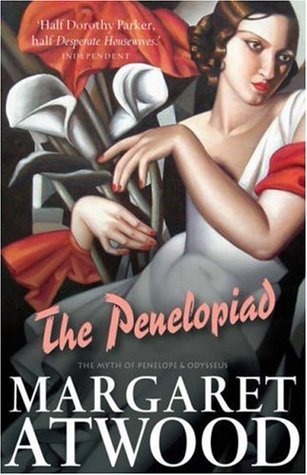
Review: The Penelopiad by Margaret Atwood

561371
THE PENELOPIAD BY MARGARET ATWOOD
Publisher: Canongate BooksFormat: Paperback
Series: No
Pages: 199
Date Finished: 13.11.15
Rating: 4/5
Summary: Now that all the others have run out of air, it’s my turn to do a little story-making.

In Homer’s account in The Odyssey, Penelope—wife of Odysseus and cousin of the beautiful Helen of Troy—is portrayed as the quintessential faithful wife, her story a salutary lesson through the ages. Left alone for twenty years when Odysseus goes off to fight in the Trojan War after the abduction of Helen, Penelope manages, in the face of scandalous rumors, to maintain the kingdom of Ithaca, bring up her wayward son, and keep over a hundred suitors at bay, simultaneously. When Odysseus finally comes home after enduring hardships, overcoming monsters, and sleeping with goddesses, he kills her suitors and—curiously—twelve of her maids.

In a splendid contemporary twist to the ancient story, Margaret Atwood has chosen to give the telling of it to Penelope and to her twelve hanged maids, asking: “What led to the hanging of the maids, and what was Penelope really up to?” In Atwood’s dazzling, playful retelling, the story becomes as wise and compassionate as it is haunting, and as wildly entertaining as it is disturbing. With wit and verve, drawing on the story-telling and poetic talent for which she herself is renowned, she gives Penelope new life and reality—and sets out to provide an answer to an ancient mystery.

“Now that I am dead, I know everything.”
I'm currently studying Classical Civilisations for one of my A Levels, and a huge part of our course centres around Homer's The Odyssey. If you weren't aware, The Odyssey is an epic poem that follows the journey of Odysseus as he tries to make his way to Ithaca (his home) from the Trojan wars. To put it eloquently, he kills a lot of shit and shags his way around the Mediterranean.

Personally, I don't find Odysseus a very compelling character. Even though he yearns to get home to his wife Penelope, that doesn't stop him sleeping with at least two other woman (a witch and a nymph, no less). He's also rude, abrasive, selfish, arrogant and occasionally foolish. I understand that The Odyssey was written in a different era, but that doesn't change the fact that Odysseus still pisses me off. 

Maybe that's why I love The Penelopiad so much. It's a relatively simple story, retelling The Odyssey from the point of view of the woman Odysseus sought to return to: Penelope. Instead of focusing on the hero who killed monsters and men alike, it tells the story of a strong woman using her own wit to stop the advances of hundreds of suitors. It gives justice to the twelve maids that were cruelly murdered in The Odyssey for crimes that a modern day audience would barely batter an eyelid to. In short, The Penelopiad is as wonderfully feminist as it is enjoyable. 
“Water does not resist. Water flows. When you plunge your hand into it, all you feel is a caress. Water is not a solid wall, it will not stop you. But water always goes where it wants to go, and nothing in the end can stand against it. Water is patient. Dripping water wears away a stone. Remember that, my child. Remember you are half water. If you can't go through an obstacle, go around it. Water does.”
It is so wonderful to read a novel devoted to Penelope. She's one of my favourite characters in The Odyssey, however Atwood creates her into a well rounded and developed heroine. She's surprisingly sarcastic and sassy (which I just loved), yet still closely resembles the Penelope we're all familiar with. Every characterisation feels true to the original and I loved it. 

One of the best things about The Penelopiad is how Atwood interprets and adapts aspects of The Odyssey. Characters are given more agency, and certain situations are shown in a new light. 
"Odysseus was the guest of a goddess on an enchanted isle, said some; she'd turned his men into pigs -- not a hard job in my view."
If I have to give any criticism to The Penelopiad is that I don't think it would work very well on its own. It's more like a short companion to The Odyssey that presents the poem in a feminist 21st century perspective rather than a novel on it's own. There are wonderful references to The Odyssey however that do really enhance the narrative. 

I'm saving the best part about The Penelopiad till last. As much as I love The Odyssey, it bothers me a lot how the twelve maids are treated. Essentially I feel like it's unjust, wrong and downright disgusting. It makes the feminist in me want to punch someone. But not in The Penelopiad. The way Atwood handles it is just beautiful, and I am so, so glad this book exists. The fact that Melantho, one of my favourite characters in The Odyssey gets her own justification makes me so happy. 
"I had the highest confidence in him, and considered him to be a sea captain who could not fail."
If you've read The Odyssey you'll appreciate how bloody hilarious that last quote is. 
 
BLOGGER TEMPLATE BY DESIGNER BLOGS